Friday, February 18, 2011

Luxury Technically Converting Car

Luxury technically transforming car
This is latest Luxury technically transforming car and whole part of body is based on latest unique idea just like interior and exterior design. And this Luxury technically transforming car is presenting great and advance theoretical luxury future and each developing ACESSERIOUS is based on latest high advance technology I mean whole part is really grand and advance.

Thursday, February 10, 2011

Innovative Concept Cars

This Peugeot Concept is well designed for the megalopolis of Tomorrow. This concept is of two types –

The First car shows for Two persons in glamorous style


The Second one for only one person used for parking place

Thursday, January 27, 2011

Volkswagen XL1 model assures 260 mpg

VW’s sleek, 1-liter two-seater owes its model cues to the Batmobile and its amazing gas mileage — .9 liters per 100 kilometers, or a predictable 260 mpg — to a combination of feather-weight clothing and a multi-technology heart. The 1,700-lb body is made largely of aluminum and carbon fiber (including a Formula One-inspired carbon monocoque), while the ingenious power plant consists of half of VW’s staple 1.8-liter TDI diesel engine mated to a seven-speed transmission. There’s also an lithium-ion battery-powered electric drivetrain, which VW says is good for 21 miles all by itself. The wicked torque inherent in all electric motors helps push the XL1 to 60 mph in a reputable 11.9 seconds, while top speed is 110 mph.


But really it’s the symbiotic nature of the two power sources operational together that could push this slippery car (with an impressive .18 coefficient of drag) into the position of eco-superstars. Consider that though XL1’s diesel engine only produces 48 hp, VW says the vehicle can preserve 62 miles an hour on just 9 hp. That’s more like gliding than driving.

The best news about the XL1 is that aspects of its innovative nature just might be break on other VW models soon. By contrast, the XL1 seats two people side by side, features normally operating doors evaluate to previous jet canopy iterations, and steer clear of overusing wildly exotic and luxurious materials such as magnesium

Thursday, January 06, 2011

Seyyed Javad Ghaffarian’s - Magical Tricycle concept

Magical Tricycle concept - Success of the student group award at the Car Design News Contest 2008, the Magic Tricycle shaped by Seyyed Javad Ghaffarian is a single concept that can be ridden as a normal three-wheeler on the highway and can also be made to run on two wheels in more crowded traffic situations. The Iranian designer built the idea around a design that would make it possible to rotate the body around a longitudinal axis operation from the front to the rear right wheel with the left wheel important into the air so the vehicle can be ridden as a motorcycle in more packed areas.


Wednesday, December 29, 2010

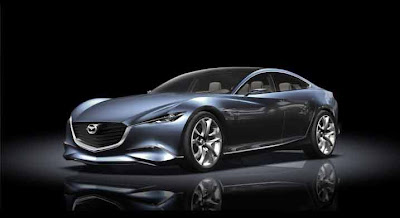
Mazda Shinari model to Debut at Paris Car Show


MILAN(Italy) — Mazda has formally exposed the Shinari, a four-door “coupe” concept that launchs the company’s new Kodo design language.

Shinari looks good enough to stand on its own, but Mazda in fact has no direct production plans for the four-seater, judging from what little its stylish shared with press at a preview here, ahead of the concept’s formal unveiling at the 2010 Paris Auto Show in late September.

Mazda highlight that Kodo — said to translate as “soul of motion” — was teamwork among its design studios in Japan, Europe and the U.S., and is planned to replace the Nagare design language that graced such recent making cars as the latest Mazda 3.

In particular, the front-end design of the Shinari, with its name aluminum wing, was explain as the new face of future Mazda production vehicles. According to Britain’s Autocar, Shinari’s “famous, gaping-mouth grille . . . does away with Nagare’s ‘smiling face.’”

The concept’s interior, calculated in California, features aluminum trim, chronometer-style gauges and leather-covered seats and surfaces, as well as an asymmetric front seating present plus deep rear buckets.

Thursday, December 23, 2010

New design Innovative upcoming Car

New BMW ZX-6 Futuristic Car Concept


nissan v2g futuristic concept car


Terrain sport coupe concept car


Morgan Futuristic concept car


future ford concept car model


vw pholeum futuristic concept car


Transforming multifunctional wheels concept car

Tuesday, November 16, 2010

Collapsible Bicycle Model by Blair Hasty


The collapsible bicycle model is designed by Blair Hasty as a vehicle for the daily transport usage. In 2004 International bicycle design competition in Taiwan, according to the model shows that the pedals shifted to behind the driver so the overall weight transfers from the lower back to forearms and pelvic bone and the posture while the rider is prostrate while riding the bike. The designer has used the space by placing a huge bag which creates a storage space for the rider. As well to add on it is collapsible and the bag will become useful. Finally it acts in two positive points, one is healthier for our body by using bicycle for daily use and other one is no need to look for parking, can take it straight to the working place

Friday, November 12, 2010

New - Audi A3 Disel


Car design - Currently in manufacture, the Audi A3 TDI was just prized the coveted title of 2010 Green Car of the Year. The diesel vehicle dispersed good gas mileage (EPA estimated 42 mpg on the highway) in a put together that is fun to drive with all the flexibility of a hatchback. We’re not sure why the diesel cars keep outsmarting the hybrids, but admit that powerful it around downtown Los Angeles was certainly a bit fun – although we might have been high by the smell of new car fumes.

Tuesday, October 26, 2010

New Sport Cars

New Car designs - Morgan LIFEcar


Mazda Furai Concept


Maserati Chicane Concept by IED


Rolls-Royce Phantom Coupé


Bentley Continental GTZ


Alfa Romeo Bertone BAT 11

Friday, October 22, 2010

Truck for Secure Transportation of Essential Supplies

This Aid Necessities Transporter (A.N.T.) was planned by Brian Lee. The vehicle is meant to carefully transport food, water, medical equipment and home items through any type of territory.


Friday, October 08, 2010

Ozone - the crazy cylinder-shaped car motorized by a fuel unit

Ozone Car
Let’s take a step back from conservative automobile design for a minute and take a glance at Ozone. This rolling cylinder shaped by Istanbul designer Özkan Koral is a design idea for a Peugeot hydrogen-powered car, where each of the giant wheels is independently motorized by electric motors.

Monday, October 04, 2010

Maintainable and Innovative Car Designs - Royal College of Art


Car Design - The annual Royal College of Art Graduate Summer Show is the place to look for modernization. The College has a section of Vehicle Design which is "pioneering new approaches for our mobile futures." This year several students presented prototypes for sustainable automobiles. They were thinking about the future and what green customers and car enthusiasts would be seems for.

Monday, September 27, 2010

Ultramodern car designs of Batley by the world’s top young designers

Bentley design
Auto
- Most welcome a ultramodern car of Batley. IN present some of world’s best young car designers from the Royal College of Art of London have at present created extra0ordinary Bentley’s car future design by the exclusive partnership of world famous British company.

Tuesday, October 06, 2009

Interesting Information on Blue Whale


The Blue whale is the largest animal to have ever lived on earth, even bigger than any dinosaur, and they can live up to 80 years or more.

Blue whales do not have teeth. Hanging down from the upper jaw are Baleen plates which look like the frayed bristles of a giant hairbrush and are used to sieve food from seawater.

When a blue whale eats, the pleats or grooves on its throat and belly expand to allow it to gulp huge watery mouthfuls of tiny, shrimp like crustaceans called Krill. Water is then forced out between the baleen plates and the food caught on the hairy fringes is then swallowed.

Due to their large size and speed, blue whales were not hunted by early whalers but were the first species to be taken by the modern whaling industry especially in the 1930's. They were then over-exploited and the population drastically reduced to near extinction. Figures suggest that today there are less than 500 in the Southern hemisphere and approximately 4,000 worldwide, out of an original population of over 200,000. Because they are an endangered species blue whales became protected in the 1960s.

The only other known predator of the blue whale is the Killer (Orca) whale. Even though the killer whale is much smaller, this does not stop organized packs or pods of them from harassing and attacking blue whales.

Blue whales are found in all oceans of the world. Being an open ocean species they are not seen near the coast but mainly in the deeper waters off the continental shelves and ice edges.

Identification

Measuring up to 30 meters long (one was recorded at 33 meters) and weighing between 100 - 200 tones, their tongue can weigh as much as an elephant and the heart is the size of a small car. The body is long and streamlined and the straight blow can reach a height of 9 meters.

Tuesday, September 29, 2009

The core measures to prevent cancer

The Key to lung Cancer Prevention
Don’t Smoke
Tobacco use is the major cause of lung cancer in the United States. About 90% of lung cancer deaths in men and almost 80% of lung cancer deaths in women in this country are due to smoking. The most important thing a person can do to prevent lung cancer is to not start smoking, or to quit if he or she currently smokes.Quitting smoking will lower risk of lung cancer compared to not quitting. This is true no matter how old one is or how much he or she

Avoid Secondhand Smoke

Make Your Home and Workplace Safer
Test for radon. Radon detectors can be purchased or arrangements can be made for qualified testers to come into the home. Health and safety guidelines in the workplace can help workers avoid things that can cause cancer (carcinogens).

Eat Lots of Fruits and Vegetables
Eating a diet high in fruits and vegetables may help protect against lung cancer.

The Key to Skin Cancer Prevention
Most skin cancers can be prevented if children and teens (and adults, too) are protected from ultraviolet (UV) rays.

Just a few serious sunburns can increase your child's risk of skin cancer later in life. Kids don't have to be at the beach to get too much sun. Their skin needs protection from the sun's harmful UV rays whenever they're outdoors.

To protect yourself and your family—
• Seek shade, especially during midday hours.
• Cover up with clothing to protect exposed skin.
• Wear a hat with a wide brim to shade the face, head, ears, and neck.
• Wear sunglasses that wrap around and block as close to 100% of both UVA and UVB rays as possible.
• Put on sunscreen with sun protective factor (SPF) 15 or higher, and both UVA and UVB protection.

The UV rays from tanning beds and sunlamps are as dangerous as the UV rays from the sun. Don't let your children or teens use them. Many states restrict the use of tanning beds by children and teens.

A Vaccine to Prevent Cervical Cancer
Human papillomavirus (HPV), a common virus that can be passed from one person to another during sex, is the main cause of cervical cancer. The same virus also causes many vaginal and vulvar cancers.

A vaccine to prevent HPV infections is available. It protects against the types of HPV that most often cause cancer. It is given in a series of three shots. The vaccine is recommended for girls 11 and 12 years old, and for girls and women 13 to 26 years old who did not get any or all of the shots when they were younger. (Girls as young as age 9 can get the vaccine.)
Parents: Help protect your daughters against cervical cancer. Make sure they get the HPV vaccine